Concept study. Speculative exploration. Not client work.
The premise
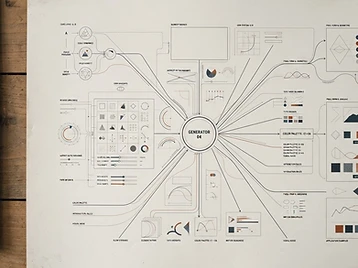
Most brands are drawings. A logo, a set of approved uses, a style guide policing them. The premise of Signals is an identity that is not a drawing but a small machine: a ruleset of type, parameters and behaviour from which every application is generated. The brand is never redrawn because it was never fixed. It is performed, consistently, by its own rules, in any context, at any size, without a human ever having to decide how it should look.
The thinking
The identity's parameters carry the brand's values: weight, density and motion map to tone, and changing the values changes the output while never breaking the character, the way a typeface holds its personality at every weight. The craft question this concept takes seriously is governance: a generative identity needs a constitution, rules about what the rules may do, because the failure mode of generative systems is not ugliness, it is drift. Signals therefore includes its own constraints: the parameters have bounds, the outputs are reproducible, and a human audits the system rather than each artifact.
What was rejected: the "AI brand" trend of endless variation with no memory, and the traditional style guide, both of which fail the same test from opposite directions: one cannot repeat itself, the other cannot do anything else.
The exploration
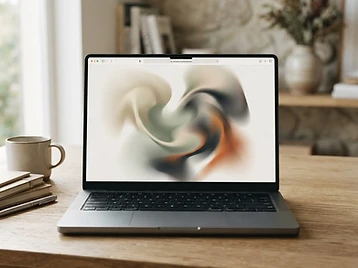
The concept was developed as a working ruleset and three application classes: poster-scale, where the system performs publicly; document-scale, where it behaves with editorial restraint; and live-scale, where it runs in a browser and responds to its environment. The signature proof is the same input producing recognizably identical character across all three, which is the entire argument of the study: consistency is a property of systems, not of enforcement.
Images (3)
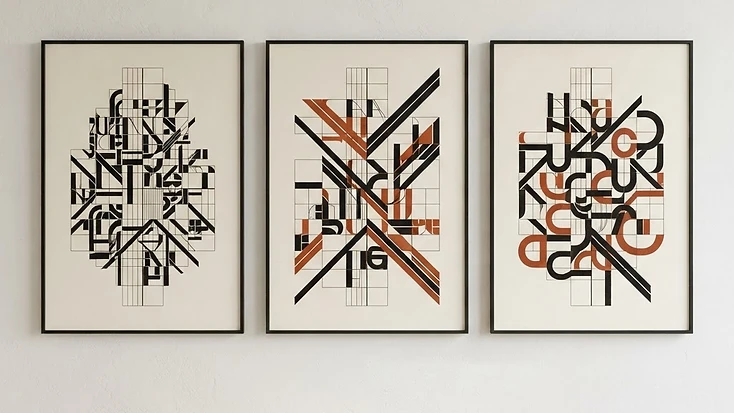
- A generated poster series: three typographic posters, recognisably one family, no invented client names.
- The ruleset diagram itself as a designed artifact: parameters, bounds, outputs.
- The identity live in a browser on a laptop, mid-generation, soft daylight.
Artifacts: the parameter diagram with bounds stated; three output samples across the three application classes.
That is the complete ten-study set: six real-work studies, four concepts, every study with title, subtitle where the title carries it, full sections, decisions with rejections, honest outcomes, and image and artifact specs for EDNA's generation pipeline. The numbers used anywhere in the set are the real ones: the bundle's £500, £950 and £1,500 tiers, the three law-change dates, the 17 November and 1 December deadlines, Evuve founded 2024, Novaen founded 2026. No em dashes, no NHS reference, no "Connect", Evuve described only as the studio.
The set now goes to Sharcross for end-to-end approval. On his GO: image generation briefs to EDNA in the shared quiet-luxury art direction, then the build, with nothing reaching the builder until he signs.