Concept study. Speculative exploration. Not client work.
The premise
A national archive opens a flagship exhibition: a century of letters, maps and manuscripts, the institution's own collection shown at scale for the first time in a generation. The premise of Codex is that such an exhibition should not be branded onto; it should be derived. The identity is generated from the archive's own cataloguing marks, accession numbers, shelf references and rules of order: the institution's internal language, the part of the collection the public never sees, promoted to the design system itself.
The thinking
Two ideas carry the concept. The collection as design material: the framing devices, typographic rules and marks are generated from real cataloguing structures, so the identity is provenance made visible, an argument the archive can defend to its own historians. And one ruleset, many surfaces: tickets, wayfinding, catalog, wall texts and a digital reading room are all outputs of the same generative system, so the exhibition feels like one coherent object rather than a brand applied to a building.
What was rejected: the heritage cliché (serifs, wax seals, parchment textures) and the modern-art-fair cliché (a bold mark and a lot of white), both of which would have made a national institution look like somebody else.
The exploration
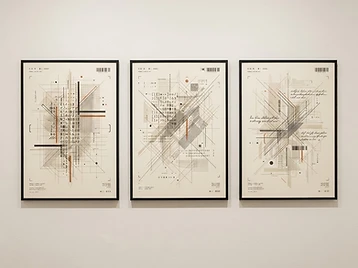
The concept was developed as a ruleset (marks, grid, type, numbering), a set of applications across print, spatial and digital surfaces, and a digital reading room in which the catalog itself participates in the identity. The signature artifact is the framing system: every document in the exhibition presented within a generated frame that cites its own accession data, turning the museum label into part of the object.
Images (3)
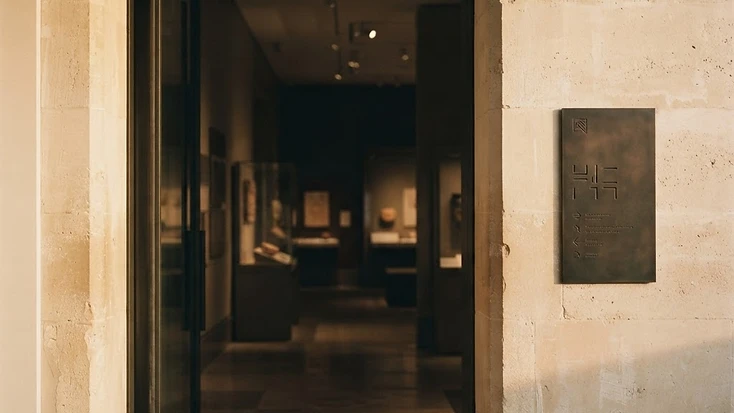
- A gallery threshold at golden hour: engraved metal wayfinding on warm stone, the identity as architecture.
- The generative framing system applied across three exhibition posters, flat-lit.
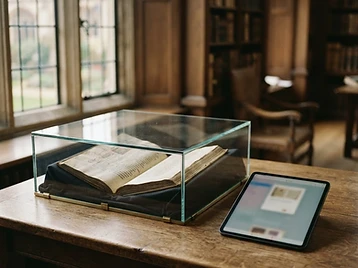
- A reading room detail: an original document under glass with the digital catalog view glowing beside it.
Artifacts: the cataloguing-marks ruleset diagram; the wayfinding system sheet; three poster outputs.